In between

four moonIt began in mystery, and it will end in mystery, but what a savage and beautiful country lies in between.                                      
                                                                           — Diane Ackerman

I’m waiting tables again. This past fall, a couple gaps in my teaching schedule left funds a little thin, so I picked up a couple nights a week at a place not far from home. Waiting tables has always been something I’ve done between other jobs, between teaching and writing and life. Often, the restaurants where I’ve worked have been staffed by artists and students and immigrants – people on their way to doing other things, people working two jobs or three to support families, put themselves through school, pursue creative projects, people between countries, languages and cultures. On top of all of those betweens, there’s the contrast between the staff racing around, keeping tabs on tables and drinks and entrees and the customers at rest, eating and drinking, catching up with friends.

Waiting tables makes me think about these collisions, these betweens. It also makes me want to go have a drink after work. So, the other night, somewhere between one day and the next, I was sitting at a bar with a couple new friends from the restaurant. Continue reading In between

The Next Big Thing

big bear sign vintage

I’ve been invited by writer, performer and activist Nikki Patin to participate in an interview series called The Next Big Thing in which authors talk about their work. (Thanks, Nikki!) You can check out what Nikki’s up to at nikkipatin.com. Since I’m kind of new at this interview thing, I’ve asked my friend Lindsay to weigh in. Welcome, Lindsay! Let’s go! Continue reading The Next Big Thing

Why I Write

fun-with-dick-and-jane-title-pageI don’t remember learning to read and write. The way my mother tells it, she discovered me at age three reading an ancient copy of Fun with Dick and Jane I’d unearthed somewhere, and I’ve been writing almost as long. Reading and writing were a continuum, not separate from one another. I loved the shape of letters – the teepee of A, the crawling snake of S. I loved stringing them into words and sentences. I loved the escape of books. They were magical objects, portals into other worlds. I didn’t think about how they came into being, the mechanics of someone sitting down to think about character and setting, cross things out, scrawl notes in the margins of typewritten pages. I didn’t dream of writing. I just wrote.

I put on plays in garages and backyards. Frankly, the audience was kind of secondary. It was the characters I was in love with. I practiced getting their voices right. IMG_0125

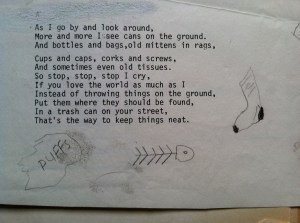
Tom Sawyer said, “You there” and Dorothy sounded plaintive; Peter Pan was cocky and Hook flamboyant. I wrote poems, too, about zebras and the ocean and pollution.

IMG_0126

I liked meter and rhyme. I liked typing and illustrating. Writing poems was play.

As a teenager, my poems moved from paeans to bubblegum and spring toward more personal subjects. I was polite, though, correct. I wrote for the A even when I was writing for myself. My journals were wilder. Sometimes I swore like a truck driver. I detailed dreams; I wrote blush-worthy, cringe-worthy things. In these pages, a different, darker, truer kind of writing began to take shape. I took just one writing class in college – poetry. I wrote pretty terrible stuff. But I was practicing. And I continued to read voraciously. I started to think I’d like to write and teach. For a long time, when people asked what I did, I put it that way, as verbs. I write versus I’m a writer. I wasn’t ready to identify as a noun. Continue reading Why I Write

early Valentine

Winter chicago snowy streetI can’t help it, sometimes I’m susceptible to a little bit of magical thinking. Supposedly, this isn’t a bad thing. It’s not unusual, at any rate. Human beings are wired to see patterns, connections, to create narrative and ritual out of the raw material of our lives. We can’t help but seek meaning. In fact, a neuropsychologist in Zurich has actually linked a lack of magical ideation to a reduced capacity to experience pleasure. People who don’t exhibit any signs of magical thinking are more likely to be depressed. So, a little magic in the heart of a Chicago winter may not be a terrible thing. It’s cold, it’s dark, the holiday hullabaloo is a distant memory, and all that remains are slushy, grey streets and long, long nights. The twinkly lights have been put away and those of us in the northern hemisphere are in for thirty-one of the coldest days and longest nights of the year. The world is crying loss, loss, loss. At least, that seems to be my January lot: loss. Jobs, relationships, pets – for two years running, January has appeared determined to kick my ass. (I know it’s February now. Believe me, I’ve been counting the days.)

This past weekend I was having one of those moments when you simply cannot take any more. I was scoured out by worry and sorrow, bone-weary and trying to get out the door to meet a friend – and I couldn’t find my cell phone. As a consequence, I was walking around my apartment yelling, “It’s not fair!” (My poor neighbors – I hate to think what they overhear. I sing to the dog to get him psyched for dinnertime or walktime – never mind the fact that, being a dog, he’s already pretty psyched about those things; I howl like a banshee because the world is not going according to my plan.) Anyway, there I was, desperately seeking my cell phone, when I heard music mysteriously coming from the bedroom. Continue reading early Valentine

Start Now

dorothy writing

10 Steps to Becoming a Better Writer
Write.
Write more.
Write even more.
Write even more than that.
Write when you don’t want to.
Write when you do.
Write when you have something to say.
Write when you don’t.
Write every day.
Keep writing.
 ― Brian Clark


I started this blog last February, a couple weeks after my birthday, to document the experience of writing my first book. As I approach these anniversaries — birthday and blog — I can’t help but take stock of where I am (writing, writing, writing), how I got here (see here) and where I’m headed next (I want to sell The Saltwater Twin and Other Mythical Creatures before 2013 draws to a close). Last week I wrote about pep talks. I kind of feel like this blog has been a yearlong pep talk to myself and anyone else who’s working hard at a creative project — or maybe just working hard at, like, life. These posts have been my inquiry into how to balance plugging away on something that’s going to take a while to finish and manage at the same time to feel some measure of contentment with life as it unwinds. Continue reading Start Now

Aragorn in the Living Room

arwen

I am currently working on a really hard chapter of The Saltwater Twin – hard because it kicks up all kinds of not very pleasant emotional turmoil. Also, my wonderful, wonderful pooch is getting old and facing illness. Also, it’s winter. In order to face these difficulties, I have been shoring myself up with hot chocolate, carrot cake and The Lord of the Rings.

I read Tolkien’s trilogy for the first time in fifth grade – I had to take breaks because the Ringwraiths gave me nightmares. Last week I looked for my copies of the books; I felt that hot chocolate/carrot cake/LOTR breaks at regular intervals would be very beneficial in navigating the difficult emotional terrain of writing this chapter and taking Levi to vet appointments. But I must have given away my yellowed paperback copies in a book purge at some point, because they were nowhere to be found. So, I ordered them on Amazon, and rented the movies to tide me over until they arrive. And I have to say, they hit the spot. It is so satisfying to spend time in a world where good is gloriously good and evil irredeemably evil, and they’re so comfortingly and clearly delineated. Good is Liv Tyler on a white horse with a gleaming silver sword, and evil looks like an orc. Continue reading Aragorn in the Living Room

grace

Cat Stretching

When I was in college I tried to wean myself off sleep. I’ve never functioned very well on less than eight hours of zzzs, and I’ve always been profoundly jealous at those who can. Sophomore year I came up with a plan to gradually reduce the amount I slept each night until I made it to – I’m not sure what my goal was – six hours? four? Turns out I’m not the only one who has had this brilliant idea. When I typed “can you train yourself to need…” into the search bar, Google right away suggested “less sleep.” This was followed by the even more ambitious, “Can you train yourself to not need sleep?” Wow. At all? Most researchers say that although individuals differ in the amount of sleep they need, a person can’t deprive herself of sleep without suffering things like fatigue, sadness, stress, anger and diminished performance. My own sleep experiment did not meet with success: I caught colds, suffered migraines and continually dozed off in the library until, bitterly disappointed, I went back to sleeping eight-ish hours a night.

This is how I’ve tended to approach most things in life. I value self-discipline, hard work, endurance. I set monster goals. If I’m not pushing myself to the limit – running faster on the treadmill, soaring across writing deadlines, checking off every last to do – I feel lazy. This leads to a lot of anxiety. It’s never – I’m never – enough. Recently, I was struggling through an intermediate level yoga class – though I’m new to yoga, I skipped the beginner classes, wanting to instantly master the fancy poses, the handstands, to get the most intense workout. We were working on some insane pose – flying pigeon, perhaps – and the instructor told us to find the place in between pushing really hard – like working really hard for it and trying to be a tough customer – and the place of sinking into the pose and sort of surrendering to it. I think she said a word to describe what this place is, but I can’t remember it. Nevertheless, the idea that there was such a place and that one might choose to rest in it, breathe into it without ferocious effort or sitting back on one’s laurels, that was a revelation.

I’ve been Googling phrases trying to find the term – the Sanskrit word for that yoga place between. No luck so far. But I did find “Playing the Edge,” an interesting reflection by a yogi named Erich Schiffman who writes that,

“Edges are marked by pain and define your limits. How far you can fold forward, for example, is limited by your flexibility edge; to go any further hurts and is actually counterproductive. The length of your stay in a pose is determined by your endurance edge. Your interest in a pose is a function of your attention edge.”

Schiffman suggests that you pay attention to these edges as they arise, that you notice them, breathe there, wait until your body tells you to deepen the pose.

I want to learn how to do this in life. I am always trying hard, working hard, getting very breathless. Schiffman asserts that if you have to steel yourself to get through your yoga practice, you’re pushing too hard; you’re fighting yourself. “Keep tabs on whether you are enjoying yourself or not,” he writes. “If not, why not? Find a way of doing the pose that is enjoyable.” It reminded me again of that day that I got nowhere close to flying pigeon – the yoga instructor told us to try to keep the beginnings of a smile on our face. Just the feeling of being about to smile.

Here’s the thing: I like my life. I like writing and teaching. I like spending time with my friends and boyfriend. I like my pets. I like taking care of them. I like taking care of my home and cooking good meals. I like exercising. But way too often, all of these good things add up to ohmygodhowamigoingtogetallofthisdonei’mfailingatlife?

So I’m going to work at finding that space between pushing and surrender. To keep tabs on whether I’m enjoying myself or not, and if not, to see what I can shift. To be interested in myself, in the moment and in what’s happening in it. And since I still don’t know what it’s called in Sanskrit – that in between place, that balancing of effort with ease – I’m going to call it grace.moon trees 2

Thank You, Virginia

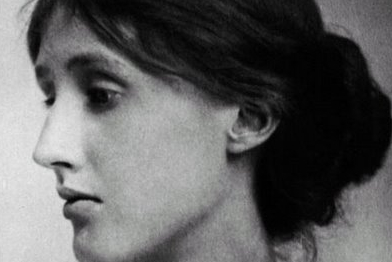
As a woman I have no country. As a woman my country is the whole world. Virginia Woolf

Last week I rode my bike up to the post office on Main in Evanston. I like that branch because it generally only has lines at Christmastime and because I like the idea of a post office on Main Street. I was there to send in a grant I’ve been working on for two months – the reason there were no October posts at The Saltwater Twin. This is the first time I’ve applied for a big grant. The $50,000 Gift of Freedom Award is offered by A Room of Her Own (after Virginia Woolf’s famous essay), a foundation that supports women writers and artists, and according to their website, it’s the largest grant of its kind to women in the United States. So, yeah, $50,000? I had to give it a try. The application was massive – five meaty essays plus a writing sample plus tax returns and all kinds of paperwork. It took many, many hours to write and assemble. And a few days ago I was finally finished. It’s mailed in. Now I just have to wait five months to find out the results.

The day I sent it in, I thought I’d be riding high – relieved and hopeful and feeling like crowing over a job well done. Instead I felt tentative, sad and anxious. Go figure. It was hard to let go of the application. I’d put so much into it, it was hard to stop and accept I’d done all I could and that was that. I’ve been thinking back to my letting go posts of late summer/early fall. Here’s another opportunity to practice. While I was working on the application, I fantasized about winning that fifty grand. That’s how I faced the seemingly endless essays and rationalized the many, many hours it took away from working on my book. I pictured sitting down for a celebratory meal, drinking a fancy cocktail, quitting my part time restaurant job and settling in to write like crazy. But once that package left my hands, all I could think was, no way am I ever going to get that award. I just spent eight weeks working on the longest shot ever. But my last post here was “Everything Is Medicine.” Writing a massive grant application? Medicine. Yes, $50K would be awesome, but I’m going to see this accomplishment as a good thing, no matter the outcome. Maybe I’ll even drink a fancy cocktail regardless.

AROHO, the foundation that gives the Gift of Freedom award, goes out of their way to support women writers. They set up a Facebook page where applicants could commiserate with and encourage one another.

(I resisted the urge to Facebook trash talk, Muhammad Ali style: “If you even dream of beating me, you’d better wake up and apologize.”)

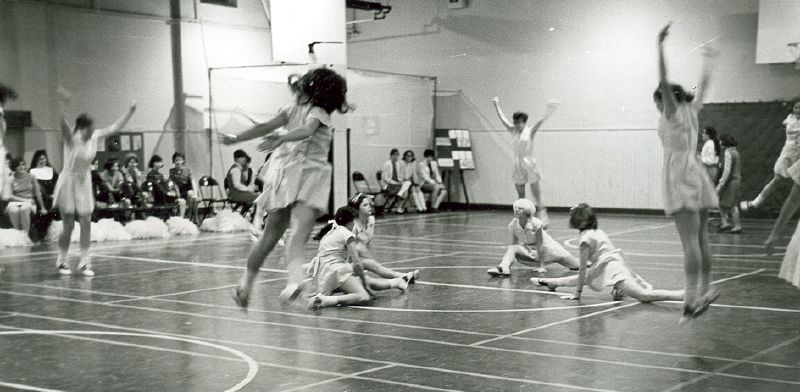
They also offered an option to sign up to receive daily, personalized “Countdown to Freedom” emails to cheer you on in the process. The emails usually consisted of an inspirational quote like this one from Diane Ackerman: “I don’t want to get to the end of my life and find that I lived just the length of it. I want to have lived the width of it as well.” I love that they did that. When I was working on “We Got Spirit!,” a monologue I performed in the Live Bait Filet of Solo Fest some years back, I had an idea for a traveling cheerleader service. It would be akin to a singing telegram – a nice cheerleader would arrive at your home or office and cheer you on in whatever challenge you were facing – whether you were a student heading into a scary test, a lonely homebody who needed to get out there and make some friends or an unpublished writer working on a book – whatever your hurdle, the cheerleader would address that in a special cheer for you. So, although I will not be stopping by in a cheerleading ensemble (even though I have one), in gratitude for Virginia Woolf, the AROHO foundation and the wonderful friends who offered feedback on my application (Thank you Ann, Harry, Jordan, Lindsay, Nick, Rick and Ruiyan), I would like to send out some cheer. If anyone out there needs support and encouragement, tell me in the comments what goal you’re trying to reach or send me an email through my website maiamorgan.com and I will cheer you on.

And now, back to business as usual: working on The Saltwater Twin, submitting essays thither and yon and perhaps occasionally sipping something fancy.

Everything Is Medicine

So, the nice literary agent in New York who continues to be very encouraging about The Saltwater Twin recommends that I stop working on it for a while and focus on submitting work for publication. She thinks two or three more publications under my belt will put us in a better position to sell the manuscript when that time comes. Consequently, while I haven’t stopped writing altogether, I’ve begun to devote half my time to researching literary magazines and websites, polishing excerpts of chapters and sending them out via email and manila envelopes…and the rejections have begun to trickle in.

I’ll be honest. I enjoy praise. I like As. It’s pleasant to have people tell me I’m wonderful, especially at something I’ve worked hard at. It feels good. But, despite the fact that praise is more fun, rejection is part of any artistic practice (not to mention part of life), and it’s helpful to learn how to take it in stride. There are thousands of blogs and websites and articles that offer advice on how to deal with getting rejected by love interests and job interests and even a whole bunch of sites talking specifically about how to deal with rejection as a writer. I like the advice of an irreverent fellow called Chuck Wendig who blogs at terribleminds:

“Every book, movie, or story you love? It’s been rejected. Probably not once. But dozens, maybe even hundreds of times. It’s part of the writer’s career tapestry, part of our blood and genetic memory. Rejection is part of who we are as creative beings. Might as well commiserate.”

So how do you deal with it? How do you keep from getting the wind knocked out of you every time? Mr. Wendig goes on to advise,

“Step to it. Suck it up. Lean into the punch. We all get knocked down. This is your chance to get back up again with your rolled-up manuscript in your hand and start swinging like a ninja…You need to see rejection as bad-ass Viking Warrior battle scars, as a roadmap of pain that makes you stronger, faster, smarter, and stranger. Rejections are proof of your efforts. Be proud to have ‘em.”

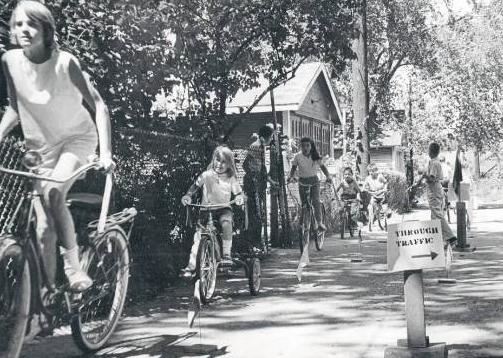
I think about learning to ride a bike. How many times I fell off, the weeks I spent with chronically bloodied knees. But I kept getting back on.

This past Saturday I went to a very interesting event called a gong bath. Maybe I’ll tell you more about that sometime. One of my favorite things – actually probably my favorite thing – about the evening happened during the introduction when the leader said, “Everything is medicine.” I like that thought. I love that thought. Everything is medicine. I am medicine. Penne with tomato cream is medicine. Rejection is medicine, too. It’s a tonic for toughening up, being persistent, weaning yourself off a need for extrinsic praise, finding satisfaction in doing the work as best you can. Getting back on the bike. Wobbling down the street until the whole balancing and pedaling and steering act is second nature. Until it feels like flying.

Letting Go, Part 2

I remember being fascinated as a kid by the way babies would grab my finger and squeeze like crazy. Even when we outgrow the reflex, we continue to reach and grasp and cling. Yet part of growing up is learning to let go. Toys break, friendships fade or (if you’re in middle school) stunningly crash and burn, grownups baffle and disenchant. Most of us learn at some point that clinging – to people, experiences, things – brings suffering. But still it’s hard not to clutch. Especially in moments when the world seems to be spinning out of control.

Four days before July turned into August, I ended up in the ER with a crazy, stupid migraine that would not go away. They gave me a spinal tap, I suppose to rule out meningitis. The migraine abated after about 24 hours, but the headache that resulted from the spinal tap stayed another eight days. Apparently it takes your cerebral spinal fluid time to replenish itself and for some people this takes longer than others. And while your body restocks the CSF, if you try to raise your head or sit up, your head is flooded with pain. The only time I managed to be relatively comfortable was lying flat on the skinniest of pillows. I don’t like skinny pillows; I like fat, fluffy ones. All told, I lost two weeks of income and was in bed nearly as long, stalled in the middle of summer, getting restless and discouraged.

At some point, as I was harrying myself with money worries and work worries and book worries and relationship worries, it dawned on me that maybe I should use the experience as chance to practice letting go. Of worry about things I couldn’t control – the hospital bill I wouldn’t be able to pay, the writing time that was slipping away. I wondered if I could even let go of needing to be out of pain. I practiced breathing. I wanted to pitch a tantrum, what a friend dubbed his two-year-old daughter’s “toddler Medea” when she lies on the ground and shrieks and flaps her arms. I practiced not panicking. I watched myself move through these things.

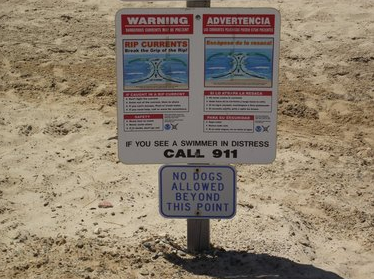
There’s been a lot in the news this summer about rip currents in Lake Michigan. Close call rescues and several awful drownings. All through August, the height of rip current season, a little red triangle around an exclamation point has popped up on my weather page: rip current alert. Rip currents are fast: they’ve been clocked at up to eight feet per second – over five miles an hour – faster than Michael Phelps can swim. Most people who drown, do so because they panic and exhaust themselves trying to swim against the current to shore. What lifeguards advise instead is to swim parallel to shore until you’re free of the current and, if the current’s too strong for that, to float on your back until it abates. Then you can swim away and back to safety.

There are rip currents in our lives. Sometimes a lot of them. Sometimes it’s rip current season. So I’m heeding the lifeguards: there’s a time to swim and a time to float. That’s the lesson I’m trying to learn. To cultivate calm, to float till there’s a break in the current and then make my way back to the sand.