Goals, Faith and Magic

photo by ShanaCathEileen

Near the end of Harry Potter book three, Harry saves himself along with his friend Hermione and his godfather Sirius by managing a complicated and difficult bit of magic. Harry has travelled back in time, where he stumbles upon his past self and loved ones in harm’s way – about to be destroyed by the ghastly dementors. Transfixed by the terrible scene, time-travelling-Harry recalls having seen a shadowy, strangely familiar figure cast the spell that repelled the dementors and saved himself and his friends. Suddenly it dawns on Harry that the familiar figure he’d seen was actually himself. So he does something he’s never been able to do before – conjures a Patronus spell strong enough to drive away over a hundred hungry dementors. When she hears of it, Hermione is stunned:

“‘I can’t believe it…You conjured up a Patronus that drove away all those dementors! That’s very, very advanced magic….’

‘I knew I could do it this time,’ said Harry, ‘because I’d already done it.’”

Harry manages it because he’d seen himself do it before.

I wish I could catch a glimpse of the future me, right now, holding the published Saltwater Twin in my hands. Then I would know I can do it. Nevertheless, despite my inability to see the future, I’m trying to believe unwaveringly that this thing I want will come to be. Continue reading Goals, Faith and Magic

Whose Story? The Ethics of Writing Memoir

I’ve been jittery ever since I found out my essay “The Saltwater Twin” would be published in Creative Nonfiction this summer. peering through curtainI know that’s the objective: I want stuff I write to be published, to be out in the world and part of conversations and all of that. But I don’t think about that while I’m writing, I just write. I sort things out, I investigate what troubles me, what makes me curious and what I don’t understand. Sometime later it sinks in that people are going to read what I wrote and that I’ve written about real people, living and breathing in the world, people who might also decide to read what I’ve written. Continue reading Whose Story? The Ethics of Writing Memoir

Strange but True Stories of Survival

photo by Sean Munson

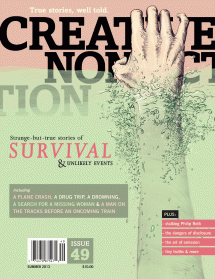
Summertime update: My essay “The Saltwater Twin” (which the observant among you will notice shares a name with this blog) is coming out in a great magazine called Creative Nonfiction. This month! As in, you can order it nowcreative nonfictionCreative Nonfiction, according to their website, “was the first and is still the largest literary magazine to publish, exclusively and on a regular basis, high quality nonfiction prose.” This issue is subtitled, “Strange but True Stories of Survival and Unlikely Events.” Editor Lee Gutkind called “The Saltwater Twin” a depiction of “the author’s struggle to avoid drowning, both literally and metaphorically.”

The essay that appears in Creative Nonfiction is essentially the first chapter of my work-in-progress, The Saltwater Twin and Other Mythical Creatures. While I continue to work towards the goal of publishing a book, a chunk of my time each week has also been spent looking for online and print publications that might be good places to submit chapters and excerpts of chapters. I was initially somewhat frantic about this task and the hours it took away from The Writing of the Book, but it’s actually been a pretty significant learning opportunity – I’m a better writer for it.  Continue reading Strange but True Stories of Survival

On Writers, Egos and Truth

Foster underpass by Jason Pettus
The writer’s job is to tell the truth…All you have to do is write one true sentence. Write the truest sentence that you know.                   
                                               – Ernest Hemingway, A Moveable Feast
 

I was thinking about two things on my bike ride down to Logan Square. Well, three. One was a feeling, really: how blissful it felt to be pedaling by the river, music ablaze in my ears, sunshine ablaze on my shoulder blades. Two was contemplating this odd task I’ve taken on of writing about myself – spending hour upon hour thinking about my life, traveling through my past. I was puzzling over why I feel driven to write about myself in this way. Are writers, specifically memoirists, monologuists, poets who draw on their personal experience, everyone who writes about themselves, are we all raging egomaniacs? The third thing I was thinking about was truth. Because when I think about why I write about myself, my life, it comes down to wanting to tell the truth. And I wondered what makes the truth so important.

I put the egomaniac question to Roger, with whom I’ve been meeting to share work and critique. We sat at a bar; I had a beer and a Cuban sandwich (which blessedly involved both plantains and pickles) while the sweat cooled on my skin.

“Are writers in love with themselves?” I asked. Continue reading On Writers, Egos and Truth

words to lift your hat to…

Thesaurus“Now there’s a word to lift your hat to…” – Emily Dickinson

When my third grade teacher, Mrs. Broadhurst, showed me a thesaurus for the first time, I was thrilled. I started peppering book reports with words like assuage and recondite. Which word was the right one? Which would say just the thing I needed it to say? I used to stare at a leaf or a wall as the day faded and ask myself, what color is it now? And moments later – now?  What pigments would I mix to get it to look like that? What word says what color that is? And when darkness took away all color, there were sounds – the rustle of sheets, a gurgle deep in the belly of the house.  A distant car outside, someone awake going where, why, at ten thirty, eleven thirty, twelve thirty at night?  There were words somewhere to say what was happening at any moment any place in the world. Continue reading words to lift your hat to…

Missed Connections: Meet me in a field of snow.

English: Snowy field
English: Snowy field (Photo credit: Wikipedia)

I started this blog to document the process of writing my first book, The Saltwater Twin and Other Mythical Creatures. If you’ve spent time here, you know I mostly write about what’s going on in my brain as I write, revise and obsess over this massive project. I spend as much time as I can on the manuscript. But in the meantime, a girl’s gotta eat. So, today I’m going to share a story from my day job. I mentioned a few weeks ago that I wait tables a couple nights a week. But by day I’m an interdisciplinary teaching artist, which means I work with students, teachers and community members in schools, healthcare centers and jails on all kinds of writing and performance projects.

I’m currently working with a seventh grade class at a Chicago public school on the South Side through one of my favorite arts ed organizations, Urban Gateways. My students are creating a performance that investigates connection – the people, places and things they feel connected to and how they are impacted by that web of connections. Seeking material to inspire student writing, I started thinking about the missed connections ads in the classified sections of local papers or on websites like Craigslist. I thought that could be a fruitful place to start an exploration of connectedness. A little digging brought me to a beautiful site called Literary Bohemian, an online journal of travel writing where I found a prose poem called “new york craigslist > personals > missed connections>” by Megan Falley.

My students and I talked about the concept of a missed connection ad. I likened it to a flyer you might see stapled to a telephone pole or tree for a missing pet or person. We talked about the people we might miss a connection with – a friend or relative who died or moved away, a fictional character we could never meet in real life or someone we hadn’t yet met, but hoped we would someday. We talked about dreams and being weird and how in poems you can use images that are dreamlike and surreal to say something about a relationship that is hard to say in words. Here are some of the poems they came up with. I think they’re pretty brilliant. We’ll use these poems and more to compile a script the students will perform at the end of May. I can’t wait to see how it turns out. Continue reading Missed Connections: Meet me in a field of snow.

Memoir & Memory

http://upload.wikimedia.org/wikipedia/commons/b/b9/Brain_page_368.jpg

Memory has been on my mind. As I’ve mentioned in this blog, The Saltwater Twin contains some elements of memoir. Working on this book has meant hours spent in my brain’s attic, rummaging through memories, emerging powdery and hoarse with dust.

Actually, that’s not the way memory works. Turns out, it’s not even a good metaphor for how it works. A memory isn’t like a letter or a photograph. It doesn’t live in one place in our brain. A memory is a pathway, it links sensory and emotional data stored in different parts of our cerebral cortex and limbic system. This is my understanding, anyway, after the twelve or so articles and one podcast I recently turned to in an attempt to get acquainted with memory. Neuroscience is like space. It’s fascinating, hard to wrap my head around and more than a little disconcerting.

Here are some more (unscientific) things that fascinate me about memory: Continue reading Memoir & Memory

The Next Big Thing

big bear sign vintage

I’ve been invited by writer, performer and activist Nikki Patin to participate in an interview series called The Next Big Thing in which authors talk about their work. (Thanks, Nikki!) You can check out what Nikki’s up to at nikkipatin.com. Since I’m kind of new at this interview thing, I’ve asked my friend Lindsay to weigh in. Welcome, Lindsay! Let’s go! Continue reading The Next Big Thing

Why I Write

fun-with-dick-and-jane-title-pageI don’t remember learning to read and write. The way my mother tells it, she discovered me at age three reading an ancient copy of Fun with Dick and Jane I’d unearthed somewhere, and I’ve been writing almost as long. Reading and writing were a continuum, not separate from one another. I loved the shape of letters – the teepee of A, the crawling snake of S. I loved stringing them into words and sentences. I loved the escape of books. They were magical objects, portals into other worlds. I didn’t think about how they came into being, the mechanics of someone sitting down to think about character and setting, cross things out, scrawl notes in the margins of typewritten pages. I didn’t dream of writing. I just wrote.

I put on plays in garages and backyards. Frankly, the audience was kind of secondary. It was the characters I was in love with. I practiced getting their voices right. IMG_0125

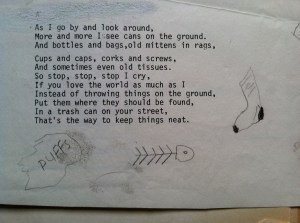
Tom Sawyer said, “You there” and Dorothy sounded plaintive; Peter Pan was cocky and Hook flamboyant. I wrote poems, too, about zebras and the ocean and pollution.

IMG_0126

I liked meter and rhyme. I liked typing and illustrating. Writing poems was play.

As a teenager, my poems moved from paeans to bubblegum and spring toward more personal subjects. I was polite, though, correct. I wrote for the A even when I was writing for myself. My journals were wilder. Sometimes I swore like a truck driver. I detailed dreams; I wrote blush-worthy, cringe-worthy things. In these pages, a different, darker, truer kind of writing began to take shape. I took just one writing class in college – poetry. I wrote pretty terrible stuff. But I was practicing. And I continued to read voraciously. I started to think I’d like to write and teach. For a long time, when people asked what I did, I put it that way, as verbs. I write versus I’m a writer. I wasn’t ready to identify as a noun. Continue reading Why I Write

early Valentine

Winter chicago snowy streetI can’t help it, sometimes I’m susceptible to a little bit of magical thinking. Supposedly, this isn’t a bad thing. It’s not unusual, at any rate. Human beings are wired to see patterns, connections, to create narrative and ritual out of the raw material of our lives. We can’t help but seek meaning. In fact, a neuropsychologist in Zurich has actually linked a lack of magical ideation to a reduced capacity to experience pleasure. People who don’t exhibit any signs of magical thinking are more likely to be depressed. So, a little magic in the heart of a Chicago winter may not be a terrible thing. It’s cold, it’s dark, the holiday hullabaloo is a distant memory, and all that remains are slushy, grey streets and long, long nights. The twinkly lights have been put away and those of us in the northern hemisphere are in for thirty-one of the coldest days and longest nights of the year. The world is crying loss, loss, loss. At least, that seems to be my January lot: loss. Jobs, relationships, pets – for two years running, January has appeared determined to kick my ass. (I know it’s February now. Believe me, I’ve been counting the days.)

This past weekend I was having one of those moments when you simply cannot take any more. I was scoured out by worry and sorrow, bone-weary and trying to get out the door to meet a friend – and I couldn’t find my cell phone. As a consequence, I was walking around my apartment yelling, “It’s not fair!” (My poor neighbors – I hate to think what they overhear. I sing to the dog to get him psyched for dinnertime or walktime – never mind the fact that, being a dog, he’s already pretty psyched about those things; I howl like a banshee because the world is not going according to my plan.) Anyway, there I was, desperately seeking my cell phone, when I heard music mysteriously coming from the bedroom. Continue reading early Valentine