
I’ve been jittery ever since I found out my essay “The Saltwater Twin” would be published in Creative Nonfiction this summer.  I know that’s the objective: I want stuff I write to be published, to be out in the world and part of conversations and all of that. But I don’t think about that while I’m writing, I just write. I sort things out, I investigate what troubles me, what makes me curious and what I don’t understand. Sometime later it sinks in that people are going to read what I wrote and that I’ve written about real people, living and breathing in the world, people who might also decide to read what I’ve written. Continue reading Whose Story? The Ethics of Writing Memoir
Strange but True Stories of Survival

Summertime update: My essay “The Saltwater Twin” (which the observant among you will notice shares a name with this blog) is coming out in a great magazine called Creative Nonfiction. This month! As in, you can order it now! 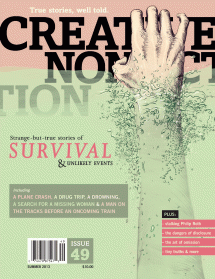 Creative Nonfiction, according to their website, “was the first and is still the largest literary magazine to publish, exclusively and on a regular basis, high quality nonfiction prose.” This issue is subtitled, “Strange but True Stories of Survival and Unlikely Events.” Editor Lee Gutkind called “The Saltwater Twin” a depiction of “the author’s struggle to avoid drowning, both literally and metaphorically.”
The essay that appears in Creative Nonfiction is essentially the first chapter of my work-in-progress, The Saltwater Twin and Other Mythical Creatures. While I continue to work towards the goal of publishing a book, a chunk of my time each week has also been spent looking for online and print publications that might be good places to submit chapters and excerpts of chapters. I was initially somewhat frantic about this task and the hours it took away from The Writing of the Book, but it’s actually been a pretty significant learning opportunity – I’m a better writer for it. Continue reading Strange but True Stories of Survival
I Am Not Trayvon Martin: Some Thoughts on White Privilege

Last Sunday morning saw a proliferation of hoodies on my Facebook home page. Hoodies and status updates shouting, “We are all Trayvon Martin!” Or sometimes, “We are all Trayvon’s mother.” These were posts by liberal, thoughtful white people — teachers and homemakers, professors and artists. I get the point. It’s a show of solidarity. And even though it’s just Facebook — even though you’re not, say, marching across the Edmund Pettus Bridge in 1965 — still you’re showing up and saying you’re sickened by the blatant racism and brutality of this incident. You’re sickened by the fact that some people are still protesting that racism has nothing to do with the murder of an unarmed seventeen year old black boy. At least that’s what I think you’re saying. But after I closed my laptop and went on with my day, I felt unsettled about all the well-intentioned white people on Facebook shouting “We are Trayvon.” Because it’s not enough. And it’s not the whole picture.
Continue reading I Am Not Trayvon Martin: Some Thoughts on White Privilege
On Writers, Egos and Truth

I was thinking about two things on my bike ride down to Logan Square. Well, three. One was a feeling, really: how blissful it felt to be pedaling by the river, music ablaze in my ears, sunshine ablaze on my shoulder blades. Two was contemplating this odd task I’ve taken on of writing about myself – spending hour upon hour thinking about my life, traveling through my past. I was puzzling over why I feel driven to write about myself in this way. Are writers, specifically memoirists, monologuists, poets who draw on their personal experience, everyone who writes about themselves, are we all raging egomaniacs? The third thing I was thinking about was truth. Because when I think about why I write about myself, my life, it comes down to wanting to tell the truth. And I wondered what makes the truth so important.
I put the egomaniac question to Roger, with whom I’ve been meeting to share work and critique. We sat at a bar; I had a beer and a Cuban sandwich (which blessedly involved both plantains and pickles) while the sweat cooled on my skin.
“Are writers in love with themselves?” I asked. Continue reading On Writers, Egos and Truth
squirrel toy rage rocket lemon
 First, some good news: the first chapter of The Saltwater Twin and Other Mythical Creatures was named a finalist for Fourth Genre’s Michael Steinberg Essay Prize! I’d post an excerpt, but I’m still working on actually getting it published somewhere, so the curious will have to wait.
Meanwhile…
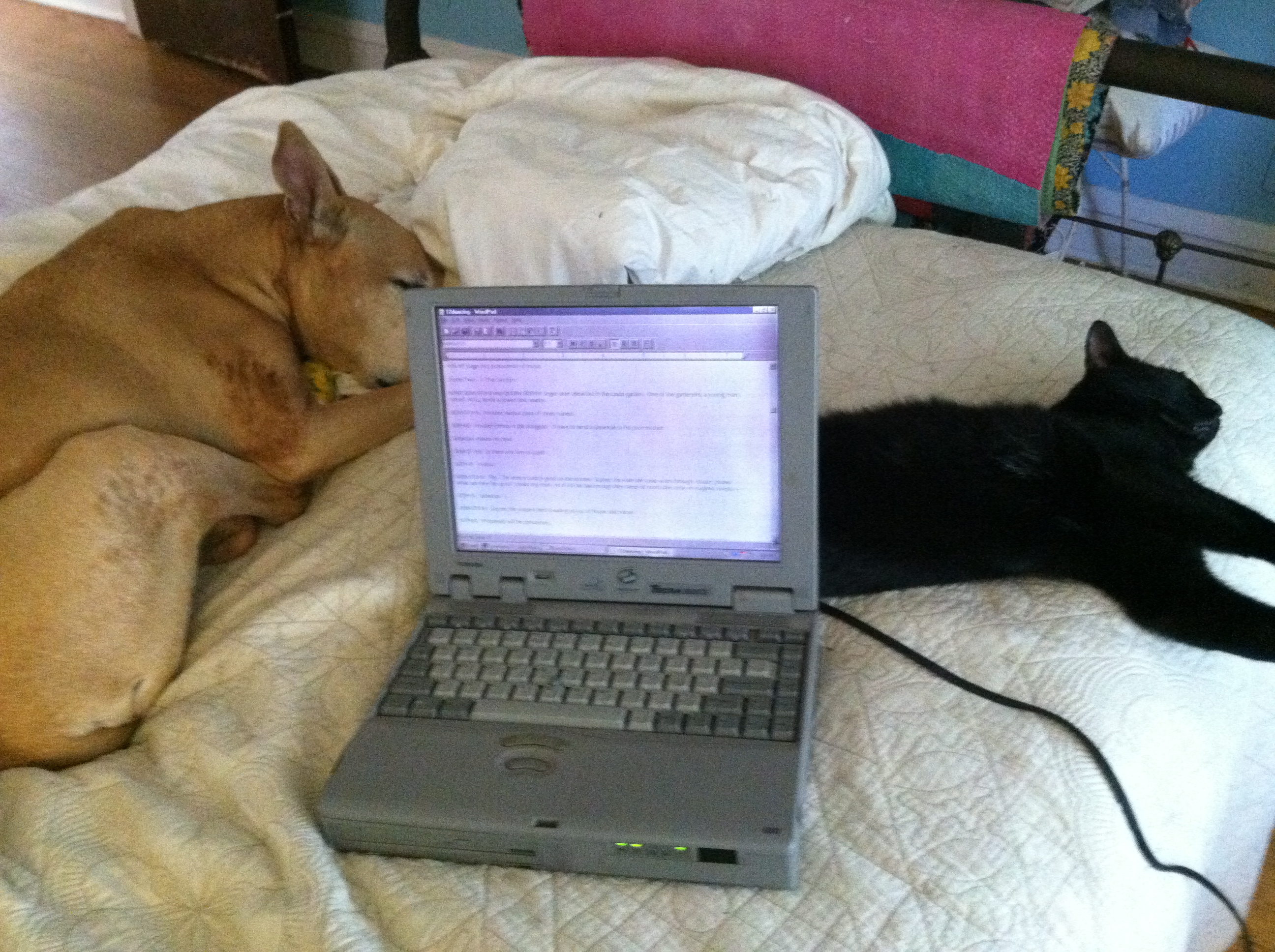
It feels like summer today. Lawnmower in the distance, fluttering curtains, susurration of leaves, chatter of birds and squirrels outside my third story window. Right now I’m doing research. Not the kind that requires library or internet or the kind that necessitates phone calls home to ask who taught me to suck the honeysuckles that grew along our backyard fence or whether it was a tire or a wooden monkey swing at that one house we stayed in that summer. Nor is it the kind of research that winds up with me on the floor amid stacks of notebooks or letters dug out of cardboard boxes from the hall closet. Today’s research involved plugging in an ancient (like over a decade old) laptop (time capsule) and meandering through its contents.
Some things it contains: Continue reading squirrel toy rage rocket lemon
Writing Road Trip

May 28, 2013. It was a Memorial Day weekend of firsts: first trip to Pittsburgh, first writers’ conference, first seitan taco.
The Creative Nonfiction Foundation in Pittsburgh publishes books and a magazine dedicated to literary nonfiction and offers workshops, mentoring and online classes. It’s entirely possible there’s an excerpt from The Saltwater Twin in a pile on someone’s desk in their office from my last round of submissions. Several weeks ago I decided to sign up for their Best of Creative Nonfiction Conference and started planning a road trip to Pittsburgh.
 May 24. My friend Jordan and I left Chicago around noon and made our first pit stop somewhere in Indiana at a really outstanding rest stop where we bought some friendship bracelets for ourselves and our Pittsburgh hosts – those kind made with the embroidery thread. I’ll never get tired of them. Jordan snapped my photo (wearing my new bracelet) next to the pouty McDonald’s girl and we fortified ourselves with some chocolate.

words to lift your hat to…
 “Now there’s a word to lift your hat to…” – Emily Dickinson
When my third grade teacher, Mrs. Broadhurst, showed me a thesaurus for the first time, I was thrilled. I started peppering book reports with words like assuage and recondite. Which word was the right one? Which would say just the thing I needed it to say? I used to stare at a leaf or a wall as the day faded and ask myself, what color is it now? And moments later – now? What pigments would I mix to get it to look like that? What word says what color that is? And when darkness took away all color, there were sounds – the rustle of sheets, a gurgle deep in the belly of the house. A distant car outside, someone awake going where, why, at ten thirty, eleven thirty, twelve thirty at night? There were words somewhere to say what was happening at any moment any place in the world. Continue reading words to lift your hat to…
Missed Connections: Meet me in a field of snow.

I started this blog to document the process of writing my first book, The Saltwater Twin and Other Mythical Creatures. If you’ve spent time here, you know I mostly write about what’s going on in my brain as I write, revise and obsess over this massive project. I spend as much time as I can on the manuscript. But in the meantime, a girl’s gotta eat. So, today I’m going to share a story from my day job. I mentioned a few weeks ago that I wait tables a couple nights a week. But by day I’m an interdisciplinary teaching artist, which means I work with students, teachers and community members in schools, healthcare centers and jails on all kinds of writing and performance projects.
I’m currently working with a seventh grade class at a Chicago public school on the South Side through one of my favorite arts ed organizations, Urban Gateways. My students are creating a performance that investigates connection – the people, places and things they feel connected to and how they are impacted by that web of connections. Seeking material to inspire student writing, I started thinking about the missed connections ads in the classified sections of local papers or on websites like Craigslist. I thought that could be a fruitful place to start an exploration of connectedness. A little digging brought me to a beautiful site called Literary Bohemian, an online journal of travel writing where I found a prose poem called “new york craigslist > personals > missed connections>” by Megan Falley.
My students and I talked about the concept of a missed connection ad. I likened it to a flyer you might see stapled to a telephone pole or tree for a missing pet or person. We talked about the people we might miss a connection with – a friend or relative who died or moved away, a fictional character we could never meet in real life or someone we hadn’t yet met, but hoped we would someday. We talked about dreams and being weird and how in poems you can use images that are dreamlike and surreal to say something about a relationship that is hard to say in words. Here are some of the poems they came up with. I think they’re pretty brilliant. We’ll use these poems and more to compile a script the students will perform at the end of May. I can’t wait to see how it turns out. Continue reading Missed Connections: Meet me in a field of snow.
Memoir and Memory II: the Theater of Memory and Ways We Forget

- Photo credit: Pulpolux
Memory is not an instrument for exploring the past but its theatre. It is the medium of past experience, as the ground is the medium in which dead cities lie interred. – Walter Benjamin
11. There is a branch of sociology (and other disciplines) called memory studies. (I am so happy about this.) It investigates things like the ways memory impacts culture and the role memory plays in collective and individual identity.
12. This makes me think of how tremendously satisfying it can feel to remember together, how it can forge and strengthen connections with others.
13. A sociologist named Paul Connerton, a pioneer in the field of memory studies, has posited that there are seven types of forgetting.
14. One of the seven types of forgetting, repressive erasure, refers to the forced forgetting of language and customs by which a government or state may seek to control a people. Forgetting as a form of violence.
15. Families do this, too. Continue reading Memoir and Memory II: the Theater of Memory and Ways We Forget
Memoir & Memory

Memory has been on my mind. As I’ve mentioned in this blog, The Saltwater Twin contains some elements of memoir. Working on this book has meant hours spent in my brain’s attic, rummaging through memories, emerging powdery and hoarse with dust.
Actually, that’s not the way memory works. Turns out, it’s not even a good metaphor for how it works. A memory isn’t like a letter or a photograph. It doesn’t live in one place in our brain. A memory is a pathway, it links sensory and emotional data stored in different parts of our cerebral cortex and limbic system. This is my understanding, anyway, after the twelve or so articles and one podcast I recently turned to in an attempt to get acquainted with memory. Neuroscience is like space. It’s fascinating, hard to wrap my head around and more than a little disconcerting.
Here are some more (unscientific) things that fascinate me about memory: Continue reading Memoir & Memory
 the saltwater twin