grace

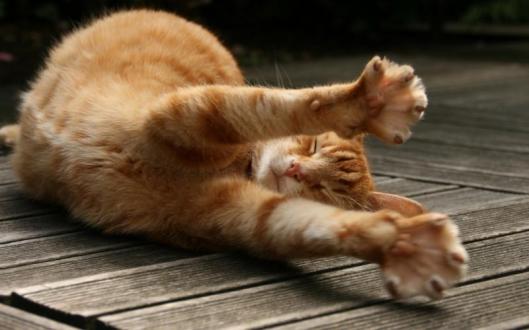
Cat Stretching

When I was in college I tried to wean myself off sleep. I’ve never functioned very well on less than eight hours of zzzs, and I’ve always been profoundly jealous at those who can. Sophomore year I came up with a plan to gradually reduce the amount I slept each night until I made it to – I’m not sure what my goal was – six hours? four? Turns out I’m not the only one who has had this brilliant idea. When I typed “can you train yourself to need…” into the search bar, Google right away suggested “less sleep.” This was followed by the even more ambitious, “Can you train yourself to not need sleep?” Wow. At all? Most researchers say that although individuals differ in the amount of sleep they need, a person can’t deprive herself of sleep without suffering things like fatigue, sadness, stress, anger and diminished performance. My own sleep experiment did not meet with success: I caught colds, suffered migraines and continually dozed off in the library until, bitterly disappointed, I went back to sleeping eight-ish hours a night.

This is how I’ve tended to approach most things in life. I value self-discipline, hard work, endurance. I set monster goals. If I’m not pushing myself to the limit – running faster on the treadmill, soaring across writing deadlines, checking off every last to do – I feel lazy. This leads to a lot of anxiety. It’s never – I’m never – enough. Recently, I was struggling through an intermediate level yoga class – though I’m new to yoga, I skipped the beginner classes, wanting to instantly master the fancy poses, the handstands, to get the most intense workout. We were working on some insane pose – flying pigeon, perhaps – and the instructor told us to find the place in between pushing really hard – like working really hard for it and trying to be a tough customer – and the place of sinking into the pose and sort of surrendering to it. I think she said a word to describe what this place is, but I can’t remember it. Nevertheless, the idea that there was such a place and that one might choose to rest in it, breathe into it without ferocious effort or sitting back on one’s laurels, that was a revelation.

I’ve been Googling phrases trying to find the term – the Sanskrit word for that yoga place between. No luck so far. But I did find “Playing the Edge,” an interesting reflection by a yogi named Erich Schiffman who writes that,

“Edges are marked by pain and define your limits. How far you can fold forward, for example, is limited by your flexibility edge; to go any further hurts and is actually counterproductive. The length of your stay in a pose is determined by your endurance edge. Your interest in a pose is a function of your attention edge.”

Schiffman suggests that you pay attention to these edges as they arise, that you notice them, breathe there, wait until your body tells you to deepen the pose.

I want to learn how to do this in life. I am always trying hard, working hard, getting very breathless. Schiffman asserts that if you have to steel yourself to get through your yoga practice, you’re pushing too hard; you’re fighting yourself. “Keep tabs on whether you are enjoying yourself or not,” he writes. “If not, why not? Find a way of doing the pose that is enjoyable.” It reminded me again of that day that I got nowhere close to flying pigeon – the yoga instructor told us to try to keep the beginnings of a smile on our face. Just the feeling of being about to smile.

Here’s the thing: I like my life. I like writing and teaching. I like spending time with my friends and boyfriend. I like my pets. I like taking care of them. I like taking care of my home and cooking good meals. I like exercising. But way too often, all of these good things add up to ohmygodhowamigoingtogetallofthisdonei’mfailingatlife?

So I’m going to work at finding that space between pushing and surrender. To keep tabs on whether I’m enjoying myself or not, and if not, to see what I can shift. To be interested in myself, in the moment and in what’s happening in it. And since I still don’t know what it’s called in Sanskrit – that in between place, that balancing of effort with ease – I’m going to call it grace.moon trees 2

Letting Go, Part 2

I remember being fascinated as a kid by the way babies would grab my finger and squeeze like crazy. Even when we outgrow the reflex, we continue to reach and grasp and cling. Yet part of growing up is learning to let go. Toys break, friendships fade or (if you’re in middle school) stunningly crash and burn, grownups baffle and disenchant. Most of us learn at some point that clinging – to people, experiences, things – brings suffering. But still it’s hard not to clutch. Especially in moments when the world seems to be spinning out of control.

Four days before July turned into August, I ended up in the ER with a crazy, stupid migraine that would not go away. They gave me a spinal tap, I suppose to rule out meningitis. The migraine abated after about 24 hours, but the headache that resulted from the spinal tap stayed another eight days. Apparently it takes your cerebral spinal fluid time to replenish itself and for some people this takes longer than others. And while your body restocks the CSF, if you try to raise your head or sit up, your head is flooded with pain. The only time I managed to be relatively comfortable was lying flat on the skinniest of pillows. I don’t like skinny pillows; I like fat, fluffy ones. All told, I lost two weeks of income and was in bed nearly as long, stalled in the middle of summer, getting restless and discouraged.

At some point, as I was harrying myself with money worries and work worries and book worries and relationship worries, it dawned on me that maybe I should use the experience as chance to practice letting go. Of worry about things I couldn’t control – the hospital bill I wouldn’t be able to pay, the writing time that was slipping away. I wondered if I could even let go of needing to be out of pain. I practiced breathing. I wanted to pitch a tantrum, what a friend dubbed his two-year-old daughter’s “toddler Medea” when she lies on the ground and shrieks and flaps her arms. I practiced not panicking. I watched myself move through these things.

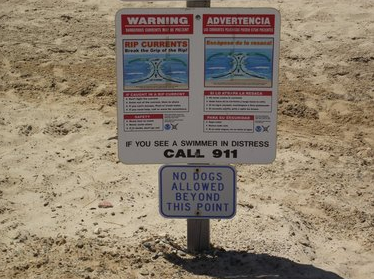
There’s been a lot in the news this summer about rip currents in Lake Michigan. Close call rescues and several awful drownings. All through August, the height of rip current season, a little red triangle around an exclamation point has popped up on my weather page: rip current alert. Rip currents are fast: they’ve been clocked at up to eight feet per second – over five miles an hour – faster than Michael Phelps can swim. Most people who drown, do so because they panic and exhaust themselves trying to swim against the current to shore. What lifeguards advise instead is to swim parallel to shore until you’re free of the current and, if the current’s too strong for that, to float on your back until it abates. Then you can swim away and back to safety.

There are rip currents in our lives. Sometimes a lot of them. Sometimes it’s rip current season. So I’m heeding the lifeguards: there’s a time to swim and a time to float. That’s the lesson I’m trying to learn. To cultivate calm, to float till there’s a break in the current and then make my way back to the sand.

Letting Go, Part 1

The last chapter in The Saltwater Twin (don’t hold your breath, friends, I’ve months to go yet) is going to be about letting go. It’s something I wish I were better at. It’s a little bit of a pickle, actually, because as a writer, it’s sort of my job to notice and hold and catalogue details, but as a human being who prefers to feel mostly happy and relatively untortured, I find letting go to be a useful skill. It’s something I keep having to learn, maybe the most important thing. As such, it seems like a fitting topic for the last chapter of a book that is something of a piecemeal memoir of my whole life so far.

It’s been a challenging month. (More on that in the next post.) This old song has been playing in my head. I couldn’t remember all the words, but I knew it was Irish; I thought The Clancy Brothers sang it. Yesterday I went online to find a version to download. Turns out “The Parting Glass” dates back to at least the 18th century, and The Clancy Brothers did often play it to end their concerts. There are different versions, of course, because it is an old, old song with, as it turns out, both Irish and Scottish roots, but here are a couple of the verses that are often sung:

Of all the money e’er I had,
I spent it in good company.
And all the harm I’ve ever done,
Alas! it was to none but me.
And all I’ve done for want of wit
To memory now I can’t recall
So fill to me the parting glass
Good night and joy be with you all.

Oh, all the comrades e’er I had,
They’re sorry for my going away,
And all the sweethearts e’er I had,
They’d wish me one more day to stay,
But since it falls unto my lot,
That I should rise and you should not,
I gently rise and softly call,
Good night and joy be with you all.

Okay, so it makes sense why this song has been playing on the record player in my brain recently, since it’s about letting go – well, saying goodbye, anyway – for a short time or a long time or forever. The melody sounds sweet and old and wistful, like the song is trying to teach you how to let go gently before the last note fades. The Pogues did a rendition and The Wailin’ Jennys, The High Kings and, of course, The Clancy Brothers. I was listening to the latter when a thumbnail image in the margin caught my attention: “Bob Dylan: Thoughts on Liam Clancy.” I clicked. In the clip, Dylan tells a story about drinking pint after pint of Guinness with Clancy someplace in Greenwich Village when Clancy said to him, “Remember Bob, no fear, no envy, no meanness.”

Yes, I am now getting my life lessons from YouTube. Because that’s one of the best things I’ve ever heard. The best advice for writing and for life.

No fear. Yep. Fear suffocates. We are our best when we throw ourselves into our work wholeheartedly without worrying about the outcome. I, for example, don’t know what will happen when I finish this book. What if no one publishes it? No one reads it? What if I’m fooling myself that I have something worthwhile to say? There are a million what ifs. But I think I’m best, I’m smartest and happiest when I can let go of the fear that things won’t turn out the way I hope.

No envy. Yep. I’ve been reading a lot of essay and memoir while working on this book. The Saltwater Twin is a collection of personal essays, a new form for me. I want to get a sense of the ways it has been done, how best to assemble a collection of work, how to create a dynamic narrative arc from stories that felt random when they were happening, how to strike a satisfying balance between story and non-narrative (but hopefully still diverting) musings. Sometimes I envy the writers I’m reading. They’ve already published books. They already have fancy websites and checks from publishers and book signings with plastic cups of wine. That envy is a fruitless pursuit, and it leads, frequently, back to fear. Who am I to think I can do this thing?

No meanness. Ah. I like that meanness has multiple meanings. Meanness, as in unkindness, does not make good art. The voices that hiss “stupid” or “worthless” or “give up now” do not make me want to sit down and type. But neither does meanness as in stinginess. I can’t hold anything back. I want to give my whole self to the work – everything I have – and freely.  This goes for life, too, of course. You are a genius, Liam Clancy!

So, my lads and lasses, my comrades and sweethearts – letting go of fear, of envy, of meanness. Will you fill a glass and toast with me to that?

the courage of your lungs

It’s June already. Summer is breathing down our necks. How did this happen? I’ve been working hard all spring, but teaching a full load of classes and workshops (oh, and trying not to be a hermit because that never ends well) has meant that I’ve only completed one 7,000 word chapter, “Law of the Jungle” over the past several weeks. But summer’s nearly here, and that makes me feel energized and alive and ready to run. I know just a few weeks ago I wrote a post “In Praise of Slowness,” but now I’m kind of in the mood to go fast. Not a teeth-gritted-when-is-this-hell-going-to-be-over kind of fast, but the kind when your body just begs you to run.

One afternoon this spring I asked the students in my after school program to write images that showed relationships. They wrote of grandmothers dancing at family reunions, a woman chasing a man and throwing her high heels at him, a father marveling over his infant son’s feet. One student wrote: Two girls running, the wind blowing their hair back.”

(If you want to, you can pretend you’re listening to the “Chariots of Fire” theme as you read the rest of this post.)

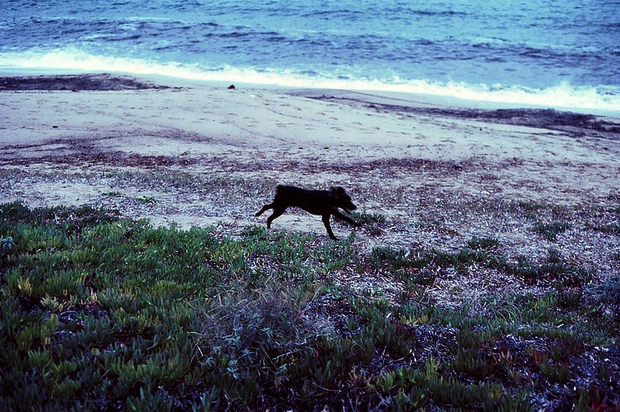
That’s the kind of running I mean – when your lungs ache and your legs get a mind of their own, running like a kid, running toward nothing. The goal is not the goal, you just open up and run like a smiling dog on the beach. So that is my summer plan. I have a goal in mind. It’s a big goal, a lot of chapters. But I’m going to set my mind on running for the joy of running and see how that works out.  And when my lungs ache I will remember running in my college town through fields of corn you could practically hear growing, wisps of clouds in the sky, worn pavement rising to meet my feet.  I’ll revel in my fleet feet, my capacity to move and breathe and feel the sun and wind on my skin.

This summer I’m running. Who’s in?

You could go in any direction, fast or slow as you wanted, fighting the wind if you felt like it, seeking out new sights just on the strength of your feet and the courage of your lungs.

                                                                                                        – Jesse Owens

finding the trail

Image

Friends, I love me some research.

It’s just so satisfying finding stuff out about stuff.

While writing this latest chapter, I’ve looked up the paleo-diet which recommends that you eat the way our Paleolithic hunter-gatherer ancestors supposedly did (my favorite proponent is this guy whose catchphrase is “Die biting the throat;” you can get it on a t-shirt!), Isaiah 11: 6-8 (The wolf shall lie down with the lamb and so on), Quakers, how long it takes to grill a rare steak, if fish are capable of feeling pain, evolution and natural selection and, as I wrote about in this space a couple weeks ago, predatory animals, especially the ones that sometimes eat humans.

I’ve come to think that even if it seems like procrastination at times, research is a fundamental part of my writing process.  I’m trying to emulate one those super wilderness scouts who can look at the-ever-so-slightly-bent twig or the barely-there footprint and gauge exactly how far off whatever you’re looking for is and what it had for lunch.

Admittedly, I do sometimes get a bit sidetracked.  The other day I was looking up Edward Hicks’ famous painting “The Peaceable Kingdom,” which my mom always used to take us to see at the National Gallery of Art in D.C., and which always fascinated me not only because of the animals’ really odd expressions but also because they were playing with those weird-looking, early American folk art babies…Image

and then I had to read about Quakers because Edward Hicks was a famous Quaker and then I started thinking, wow, I’ve always thought Quakers were really cool and maybe I should be a Quaker and then I started looking up Quaker meetings in Chicago —

that was maybe a tich off the beaten path.

So I try to balance research and writing.  But when I stumble across some semi-hidden sign, catch a trace scent in the air that leads me to a brand new thought or connection or story, it’s really kind of thrilling.  I don’t know if I’ll find exactly what I’m looking for (a thorough understanding of why and how everything in the world universe is what it is and does what it does) but at least I’ll have an account of the expedition.

In Praise of Slowness

I’ve been working on The Saltwater Twin for about a year now in earnest.  I’m about halfway there, I think, and I’m impatient.  It’s slow going. I get antsy when I finish yet another draft of a chapter and realize it’s still not done.  I have to go back and work on it some more.  Maybe even set it aside and come back to it in a few days or weeks.  It is a little-by-little process of finding a path forward, looping back around, creeping forward again.  I write many, many drafts. There are pages of typed and penned rambling that end up discarded, but lead to what will stay in the end.  Sometimes there is research to be done.  And of course there are mundane distractions like laundry, groceries, dog walks and earning a living.

So I have noticed a couple things.  1. Being impatient does not make me write better or faster.  It just ratchets up my anxiety, and I am not a big fan of anxiety. 2. I think I am a little bit slow by nature.  As a kid I was always getting left behind in museum exhibits.  I liked to amble and think and explore till someone came to scold me for lollygagging and herd me back to the rest of the group.

So, in light of 1 and 2,  I’m going to try to be okay with being slow.  Maybe even embrace it.  And though I’m impatient about wanting to see how this whole book thing is going to turn out, I’m going to try to pay attention to how it is to be in the thick of these green and growing leaves right now.  It’s not a bad place to be.